




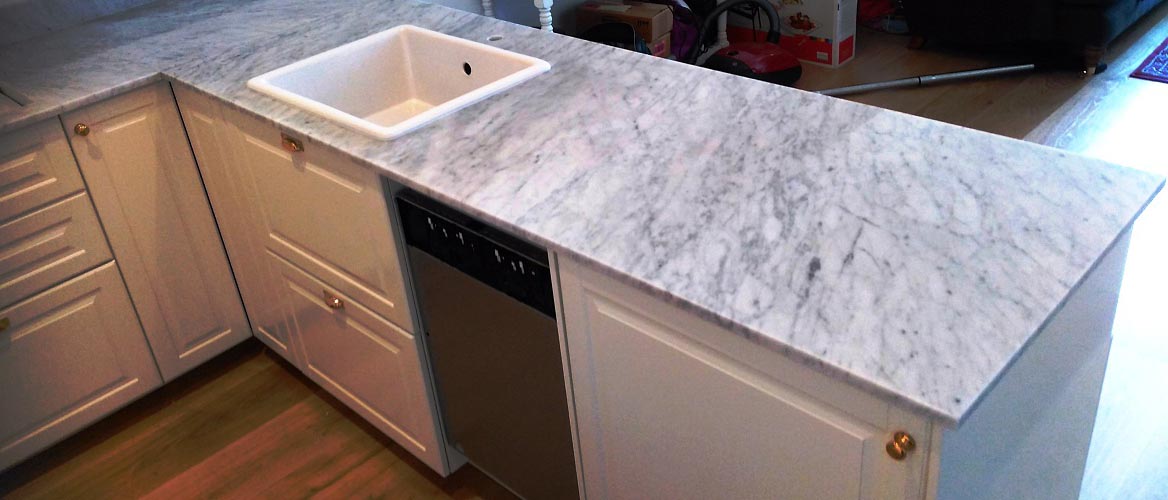
Carrara marble kitchen worktops suit households that value the individual beauty of natural stone and accept that it will develop signs of use. In particular, their soft grey veining complements many kitchen styles. However, marble can scratch, stain and etch, so it requires more thoughtful care than many engineered surfaces.
For the right project, Carrara marble can create an elegant worktop, island or splashback. Before choosing it, buyers should compare full slabs, consider the preferred finish and discuss fabrication with an experienced stone specialist. After all, the term Carrara marble worktop describes a natural material with considerable variation rather than a perfectly uniform manufactured pattern.
What is Carrara marble?
Carrara marble comes from the Carrara area of Tuscany in Italy. Typically, it has a white to pale grey background crossed by fine grey or blue-grey veins. Because it is a natural stone, each block and slab differs in tone, markings and mineral features.
Furthermore, the material has a long architectural and sculptural history. For example, Carrara marble appears in important Roman buildings, including the Pantheon and Trajan’s Column. Moreover, sculptors associated with Italian art and architecture, including Michelangelo and Nicola and Giovanni Pisano, worked with marble from the region. Consequently, that history helps explain the stone’s enduring association with classical design.

Why choose Carrara marble kitchen worktops?
Natural colour and distinctive veining
Bianco Carrara marble worktops offer a lighter, softer appearance than many strongly patterned stones. As a result, their restrained veining can complement painted cabinetry, natural timber and dark finishes. In addition, every slab has its own pattern, so the completed kitchen will not look mass-produced.

Flexible design applications
Carrara stone works in traditional, contemporary, Scandinavian-inspired and transitional interiors. For instance, it can form perimeter worktops, an island, a splashback or selected feature panels. However, a designer does not need to use it across every surface. Instead, a marble island can provide a focal point while another material serves a busier preparation area.
A naturally cool preparation surface
Marble feels cool to the touch, which can make it appealing for rolling pastry and handling dough. In addition, it tolerates normal kitchen warmth. Nevertheless, MKW advises using trivets for hot cookware because thermal shock and prolonged heat can affect the stone, sealant or nearby joints.
Workable natural stone
Specialist fabricators can cut Carrara marble for sinks, taps and hob openings and can also form suitable edge profiles. However, marble is softer than many granite worktops, so narrow sections and cut-outs require careful planning. Therefore, professional templating, fabrication and installation matter.
What are the limitations of Carrara kitchen worktops?
Carrara marble contains calcite, which reacts with acids. Consequently, lemon juice, vinegar, wine and some cleaning products can leave dull marks known as etching. Although a suitable sealer can slow liquid absorption, it cannot make marble acid-proof or prevent every mark.
Furthermore, the surface can scratch or chip under impact. Therefore, users should prepare food on chopping boards, wipe spills promptly and avoid dragging rough cookware across the stone. These habits help; nevertheless, they cannot keep natural marble permanently unchanged.
Some owners appreciate the patina that develops over time. By contrast, others prefer a surface that retains a more consistent appearance. Anyone in the second group should compare marble with quartz, porcelain or other options before deciding. Therefore, MKW’s guide to the differences between Carrara marble and Carrara quartz offers a useful starting point.
Should Carrara marble be honed or polished?
A polished finish reflects more light and strengthens the apparent contrast between the background and veining. However, etching may look more obvious because acidic substances disturb the reflective finish.
By comparison, a honed surface has a smooth, matt or low-sheen appearance. Consequently, it can suit understated kitchens and may make minor wear less conspicuous. Even so, honing does not stop stains or acid etching. Therefore, buyers should view finish samples alongside their cabinetry and lighting before approving the specification.
Notable varieties of Carrara marble
Stone names and grading conventions can vary between quarries and suppliers. Furthermore, two slabs sold under the same name may differ visibly. The following names describe options historically associated with the Carrara family or the wider Italian white-marble market. Therefore, buyers should judge each slab rather than rely on its label alone.
Bianco Carrara Venato
Bianco Carrara Venato Marble generally features a pale background with visible grey veining. Because its movement can appear relatively restrained, it may suit worktops, wall finishes and other interior applications. Before ordering, buyers should review the complete slab and agree where prominent veins will appear.

Calacatta and Carrara
Calacatta Carrara Bianco Marble appears in the original range material as a brighter Italian marble with bolder veining. However, Calacatta and Carrara usually refer to distinct commercial marble families, even though both originate from the wider Carrara region. Therefore, customers should confirm the supplier’s precise stone name and inspect the slab rather than assume that the terms are interchangeable.

Carrara C
Carrara C Marble commonly has an off-white to light grey background with fine grey veins. As a result, it can create a quieter surface than a heavily figured statement marble. Consequently, it often pairs well with detailed cabinetry or patterned flooring.

Carrara C Extra
Carrara C Extra is generally selected for a lighter background and refined-looking pattern. Nevertheless, variation remains part of the material even within an “Extra” selection. Depending on the chosen slabs and fabrication plan, the fabricator may also be able to match or bookmatch veins.

Bianco Carrara Extra Honed
Bianco Carrara Extra marble honed combines a selected Carrara appearance with a low-sheen finish. In particular, the matt effect can soften reflections under bright kitchen lighting. Nevertheless, this finish needs the same sensible protection from acids, abrasives and prolonged spills as other marble surfaces.

Carrara Bella
Carrara Bella Marble may include soft grey markings and warmer mineral tones. Consequently, those warmer details can coordinate with brass-coloured accents and timber cabinetry. However, buyers should confirm with the fabricator which finish options suit a kitchen worktop.

Bianco Carrara Gioia
Bianco Carrara Gioia is associated with a pale ground and flowing grey veining. Compared with quieter Carrara selections, it can provide more visible movement. Consequently, careful templating helps position its strongest features across islands, upstands and adjoining sections.

Bianco Carrara Extra
Bianco Carrara Extra usually denotes a lighter or more selectively graded Carrara appearance. However, “Extra” does not promise a completely white or uniform slab. Instead, natural veins, tonal changes and mineral features should form part of the design decision.

Bianco Carrara Extra first selection
Bianco Carrara Extra 1st Marble is a commercial selection name rather than a guarantee that every supplier grades stone identically. For that reason, customers should request current slab photographs or view the slab in person. In addition, they should ask how joints, veins and cut-outs will align.

How should Carrara marble kitchen worktops be maintained?
- Firstly, wipe spills promptly, especially citrus juice, wine, vinegar, coffee and cooking sauces.
- Next, use a soft cloth with a pH-neutral cleaner suitable for natural stone.
- Moreover, avoid acidic cleaners, abrasive powders, scouring pads and unsuitable bleach-based products.
- In addition, use chopping boards, trivets and coasters to reduce scratches, impacts and heat exposure.
- Finally, check the sealer periodically and follow professional guidance rather than a fixed resealing timetable.
For a fuller routine, see MKW’s Carrara marble care tips. Furthermore, owners should consult a stone-care professional if a surface develops deep stains, chips or widespread etching. Otherwise, an aggressive DIY treatment could make the problem worse.
How should Carrara stone worktops be planned and ordered?
First, customers should choose cabinetry, appliances and sink details before templating. Next, they should discuss unsupported spans, overhangs, tap holes, drainer grooves and joint positions with the fabricator. After all, these details affect both appearance and structural performance.
Moreover, buyers should compare whole slabs rather than relying on a small sample. Although a sample can show the base colour and finish, it cannot represent the full vein pattern. For multi-slab kitchens, customers should also ask whether the selected pieces come from compatible blocks and how the fabricator plans to arrange them.
Costs vary with slab selection, thickness, finish, site access, edge treatment, cut-outs and installation complexity. Therefore, a project-specific quotation is more useful than an outdated square-metre estimate. Customers can ask MKW for a tailored quotation based on drawings, measurements and the preferred material.
Are Carrara marble kitchen worktops the right choice?
Carrara marble kitchen worktops make a strong choice when natural variation, tactile character and a timeless pale surface take priority. However, they may not suit anyone who wants a highly uniform worktop or minimal sensitivity to acidic spills.
Before committing, customers should compare natural marble with a marble-inspired engineered surface. For example, MKW’s guide to marble-look engineered quartz outlines another design route. Alternatively, customers can request an MKW quotation to compare suitable materials and fabrication requirements for their kitchen.
Frequently asked questions
Does Carrara marble stain easily?
Unsealed or poorly maintained marble can absorb liquids. Moreover, even sealed stone may stain when spills remain on the surface. Therefore, prompt cleaning and suitable sealing reduce the risk, although they cannot eliminate it.
Can lemon juice damage Carrara marble?
Yes. Because lemon juice contains acid, it can react with calcite and leave dull etched areas. Therefore, users should wipe acidic spills immediately, although fast cleaning cannot always prevent a mark.
Is honed Carrara marble better for kitchens?
Neither finish is universally better. On the one hand, honed marble has a softer, low-sheen look and may disguise minor wear more readily. On the other hand, polished marble looks brighter, but etching can appear more conspicuous.
Can Carrara marble be used for splashbacks?
Yes, subject to appropriate specification and installation. For example, a matching splashback can create visual continuity. Alternatively, a contrasting design can limit the amount of marble needed.
Should buyers select the slab before fabrication?
Yes, whenever practical. Firstly, viewing the full slab helps buyers assess colour, veining and natural features. Secondly, it allows the fabricator to discuss the best position for prominent markings.
Published by Jesus Alberto Mouzo on June 10, 2019


